Authors: Jeanne Crampette: Heritage Protection Coordinator at ICOM Secretariat; Rachelle Kalee: Museums & Society Coordinator at ICOM Secretariat; Jenny Newell: Curator, Climate Change, at the Climate Solutions Centre of the Australian Museum in Sydney (ICOM SUSTAIN Board member); Luiz Souza: Full Professor at the Federal University of Minas Gerais (ICOM Brazil); Yacy-Ara Froner: Full Professor at the Federal University of Minas Gerais (ICOM Brazil); Cecilene Muller: Assistant Director of Research, Planning and Policy at Heritage Western Cape (ICOM South Africa); Catherine Snel: Archivist and Museologist at Sanlam Ltd (Chair of ICOM South Africa
Keywords: G20, ICOM experts, priority 4, climate change
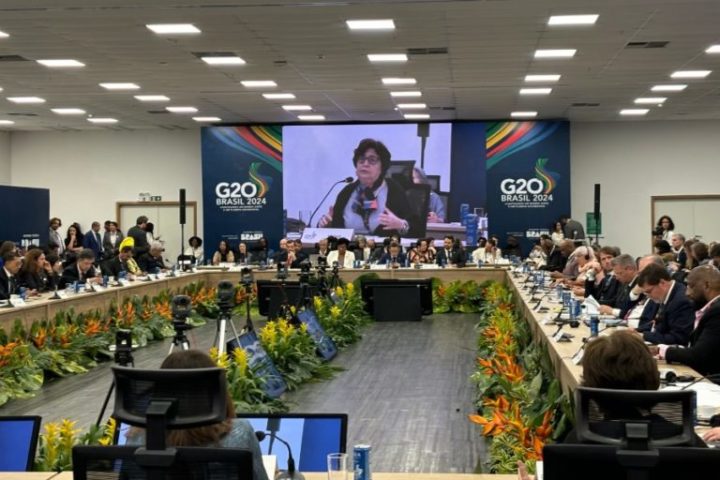
For the fourth year, ICOM has been invited to participate as an observatory member to the G20 Culture Working Group, hosted this year by South Africa under the theme “Solidarity, Equality and Sustainability”. To prepare its contribution to the 4 priorities chosen by the South African presidency of the G20, ICOM is relying on experts from its network. ICOM Voices is highlighting the contributions of these experts through a series of articles, giving them a space to share their views and the work of museums in these areas.
This first article presents the work of our experts on priority 4, “The intersection of Culture and Climate Change: Shaping Global Response”.
In April 2025, members of the ICOM Secretariat and ICOM SUSTAIN responded to a request from the G20 Culture Working Group for expert advice about the role of museums in the face of climate change. The ICOM team created a short statement, which was presented by a representative of ICOM SUSTAIN at a webinar designed to inform the G20’s policy in October. The G20 is taking place this year on the African continent, specifically South Africa – a paradigm shift that reaffirms the need to centre voices and knowledge systems that have historically been sidelined in global environmental negotiations.
The climate emergency is a human crisis, in its causes and its solutions. It requires an awakening of imagination, of memory, of listening — and of care. This is precisely where culture, and particularly museums, can play a decisive role. Museums and other cultural institutions are not only spaces of preservation: they are infrastructures of care, operating through civic engagement and providing valuable conduits for
communities. As trusted sources of information, they are an increasingly important anchoring point for citizens dealing with rising seas of misinformation.
Museums’ engagement in addressing climate change plays a vital role in advancing the objectives of Action for Climate Empowerment (ACE), as outlined in the Paris Agreement. By fostering access to dialogue, capacity-building, and participatory pathways, museums empower civil society to contribute meaningfully to climate action. Governments and museums must collaborate to reduce carbon emissions and to support the regeneration of nature and the safeguarding of communities.[1]
ICOM’s presentation to the G20 Culture Working Group made three key points, establishing that more museums are stepping up to empower communities to face the climate crisis through (1) storytelling and listening, (2) deploying Indigenous approaches and (3) providing refuge.
1. Museums Promote Action Through Storytelling
Around the world, more museum teams are starting to step up as catalysts for climate awareness and solutions. They are inviting their publics to contribute their stories of how to live well, now and into the future. In South Africa, the Kleinplasie Living Open-Air Museum is embracing this narrative responsibility. Through the revival of traditional medicinal plant knowledge, the museum shares stories of healing and resilience. One of the plants taking centrepiece is Sutherlandia frutescens (locally known as cancer bush, bells bush, etc.) which is cultivated not only for its drought-resistant properties but for its deep cultural significance among numerous cultural groups occupying Southern Africa. Museum educators facilitate storytelling circles, where elders recount the plant’s uses in centuries-old rituals and healing practices. The museum is thus a living storybook of Southern Africa’s ecological and cultural knowledge, affirming that Indigenous knowledge and oral heritage are vital tools for climate adaptation.
Some museums, like the Manchester Museum, are also helping to regenerate local communities and ecologies by asking and supplying what local environmental and social justice groups want: a convening space on the top floor of the museum, a place to build collaborations. Dedicated climate museums in New York, Hong Kong, and Europe are making visible the impacts of burning fossil fuels and the treachery of the fossil fuel industry. They invite poets, artists and forest defenders to express themselves, becoming spaces of exchange that bring people together. This enriches the attendees’ experiences and has an impact on the actions they subsequently choose to carry out.
People enter museums expecting to learn, be inspired, and to find answers to climate change’s perennial question: what can I do? To answer this question, the Australian Museum’s Climate Solutions Centre records, documents and tells the stories of people working to create better futures. This has informed and provided content for Future Now, a popular exhibition of dioramas of sustainable and regenerated landscapes. The exhibition tours to urban and rural civic spaces. The futures featured in the exhibition allow visitors to envision their own version of a better future, sparking conversations that are solution-focused. Monthly ‘Coffee & Climate’ discussions at the museum are also helping attendees to build confidence to talk to others, and commit to reducing emissions. From telling stories of action being taken in our communities, the museum is fostering hope and witnessing positive changes rippling outwards.
2. Museums promote Indigenous knowledge in support of Climate Action and Resilience
Indigenous knowledge systems offer culturally-rooted responses to environmental degradation, offering models for co-existence and sustainability. The Kleinplasie Museum mentioned earlier, incorporates both indigenous and Western knowledge systems into its heritage farming programs. These programs preserve and present cultural history by passing down knowledge, skills, customs, and practices across generations, as well as showcasing physical representations of community values and beliefs. Consultative workshops co-curated with Khoisan (Hessequa) and isiXhosa elders ensure that intergenerational transmission of traditional knowledge occur as required by South African legislation.
Ensuring substantial Indigenous participation within cultural institutions enables an institutional culture shift. Sustained Indigenous consultation and consent ensure there is: ‘nothing about us without us’.[2] In Brazil, a new generation of Indigenous-led museums and cultural initiatives is emerging as a vital force for regeneration and resilience. The Museu das Culturas Indígenas [Museum of Indigenous Cultures], inaugurated in São Paulo in 2022, is governed by an Indigenous council and emphasises Indigenous perspectives on land, spirituality, and contemporary life. In the northeast, the Museu do Índio Luíza Cantofa, opened in 2023, preserves the history and traditions of the Tapuia Paiacu and Tabajara peoples through a fully community-driven approach.
The Museu Indígena Pataxó in Coroa Vermelha, originally created by government initiatives in 2000 during the official celebrations of Brazil’s 500th anniversary − a date perceived by Indigenous communities not as discovery, but as an invasion – is another example of the changes taking place in Brazil. After years of neglect and closure, the museum was reclaimed and reborn in 2024 under genuine Indigenous leadership, with new collections and curatorship directly shaped by the Pataxó themselves. This wider movement towards Indigenous agency was also visibly present at the 35th Bienal de São Paulo, where Indigenous artist Denilson Baniwa, along with contemporary artistic collectives such as MAHKU, contributed not only artworks but also curatorial perspectives, challenging colonial structures within one of Brazil’s most prominent art events.
These initiatives are no longer just beacons of hope, dialogue, and transformation: they have become actions of resilience, resistance, and Indigenous protagonism, in which Indigenous people are fighting to reclaim rights, restore memory, and amplify authentic Indigenous voices — voices that speak for themselves and are not filtered through external interpretations. Despite ongoing challenges posed by political resistance and prejudice, Indigenous communities in Brazil are reclaiming both their memory and future, using museums, exhibitions, and cultural platforms as vital instruments for affirmation, regeneration, and the defense of life.[3]
A gallery at the Australian Museum, Wansolmoana (One Salt Ocean), offers an example of community co-curation and powerful climate storytelling through video and cultural objects. Staff are working to connect the gallery to Sydney’s large Pasifika communities and climate action groups such as Pacific Climate Warriors, encouraging pride in culture and histories of resistance to colonial and capitalist exploitation.
3. Museums as Refuges in Disaster
Built to keep collections safe, museums can also provide physical support for local communities when struggling with heatwaves, floods and fires. For example, after Hurricane Gilbert, the National Gallery of Jamaica provided shelter for many who had lost homes, as it was one of the few intact buildings with backup power generation.
In South Africa the Old Harbour Museum in Hermanus, located on the increasingly vulnerable Overberg coastline, has become a model for how small museums can function as both a museum and a climate refuge. During recent storm surges, the museum opened its doors to stranded residents and tourists, offering safety, communication, infrastructure and guidance. In response to climate change and particularly sea level rise, the museum launched its “Safe Harbour Initiative”, equipping its building with solar-powered emergency systems, water purification, and training for climate risk response.
Beyond emergency use as a refuge during disasters, the Old Harbour Museum is also used as a space and platform to foster community engagement by preserving coastal memory through its Tides of Change exhibition, a participatory platform for local fishers, poets, scientists and youth to share their stories about the sea − stories of loss, transformation and hope. These stories are paired with climate data and community forecasts, making the abstract realities of climate change personal and actionable.
The case for support for climate action and climate risk preparedness
The recommendation we made to the G20 Culture Working Group was to increase governmental support for collection care and encourage learning through educational experiences that actively involve stakeholders.
Museums need more support and clearer imperatives from governments to step up to climate education.
Science and technology collections in universities and public institutions as well as cultural collections often need stronger infrastructure as climate risks rise. These collections remain essential resources for understanding histories of humans and fellow species as well as building pathways to sustainable futures for all.
We also stressed the strategic importance and increasing relevance of combining knowledge, research and collections of both scientific and traditional knowledges. These systems of knowledge are complementary and both require recognition, preservation, and public investment. Examples highlighted that communities have always adapted and flourished in the face of environmental change.
We pointed out that it is important for governments to integrate Indigenous Knowledge Systems into their Nationally Determined Contributions (NDCs) and National Adaptation Plans (NAPs), and to support museums and archives that work with their communities to document and transmit their traditional knowledge.
Finally, ICOM emphasised the need to recognise culture as part of non-economic loss in climate negotiations and loss-and-damage mechanisms, acknowledging that the impacts of climate change go beyond material damage. They affect identities, memory, rituals, and the cultural fabric of communities. This recognition is essential to ensure that cultural loss is visible, valued, and supported in international climate financing and recovery mechanisms.
ICOM’s presentation concluded by highlighting that with support, museums can realise their potential as tools for learning, imagination and care, helping us all to regain our ability to act in our increasingly challenging world. The G20 Culture Working Group referred to several of the key points within the statement during the discussion sessions. ICOM’s contribution to the G20 stems from its established presence in over 120 countries, through a global network of more than 60,000 members, capable of influencing regional policies through shared values, sustainability goals, and inclusive dialogue. The conversation between the G20 and ICOM will continue.
[1] See Henry McGhie, Action for Climate Empowerment: A Guide for Galleries, Libraries, Archives and Museums, Curating Tomorrow, 2022 ; as well as Henry McGhie, Rodney Harrison, Colin Sterling, ‘Reimagining and Mobilising Museums for Climate Action ’, ICOM Voices, 28 july 2022.
[2] See, for example, Mariko Smith, ‘Inspiring Change for First Nations Representation in Museums’, IndigenousX, 9 july 2021. E-publication, Inspiring change for First Nations representation in museums – IndigenousX [consulted on 22.4.2025] ; Linda Tuhiwai Smith, Decolonising Methodologies : Research and Indigenous Peoples, 1999, Zed Books, London. Yacy Ara Froner, ‘The cultural value of ethnographic heritage: resilience, resistance and sustainability’, Revista Vis, 23 [1] (2024). periodicos.unb.br. [consulted on 30.5.2025]
[3] Museu das Culturas Indígenas. (2022). From Home – Museu das Culturas Indígenas Brasil de Fato. (2024, February 19). Museu Indígena Pataxó reabre após mais de cinco anos fechado no extremo sul da Bahia. From Museu Indígena Pataxó reabre após mais de cinco anos fechado no extremo sul da Bahia – Brasil de Fato Dasartes. (2023). Denilson Baniwa promove colheita do milho finalizando obra da Bienal de São Paulo. From Denilson Baniwa promove colheita do milho finalizando obra da Bienal de São Paulo | Dasartes