
Dr Angela Stienne
Museum Consultant and Honorary Research Fellow, University of Leicester
Museums have no borders,
they have a network
November 27, 2026
Dr Angela Stienne
Museum Consultant and Honorary Research Fellow, University of Leicester
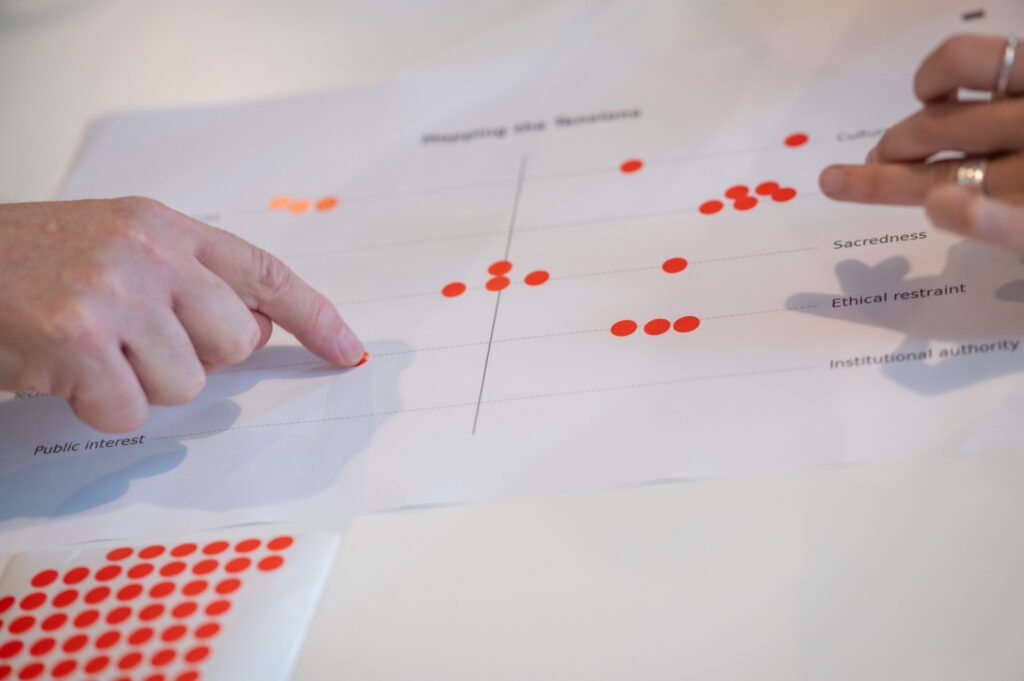
The workshops are in-person and participatory sessions inviting audiences to explore the values, competing priorities and tensions that influence decisions about display strategies and narratives in museums. The ‘mapping the tensions’ methodology uses tension maps, which take the form of simple printed documents on which participants place dots along lines that represent a spectrum of competing ideas. This activity allows participants to experience the complexity of museum decision-making across different aspects of museum operations, while providing museums with more nuanced forms of public responses and opinions than conventional visitor surveys.
While recent studies suggest that museums remain among the most trusted public institutions in the UK, the question of the display of human remains has been a divisive one. Museums are under increasing pressure to explain not just what they display but how and why they come to the decisions they make when it comes to displaying sensitive topics; and few topics are as polarising as the display of displaced human remains in Western museums. For decades, ancient Egyptian mummified bodies were excluded from debates on the ethics of human remains in museums. Long considered ‘the least problematic human remains’, museums benefited from these omissions, as mummified bodies attracted visitors not only to permanent galleries but also to touring exhibitions. However, Egyptian mummified bodies are never ‘neutral’ bodies in museums. Displaced from their resting places, they have been entangled with histories of displacement, colonialism and scientific racism.
For a decade, I have been leading public engagement around the question of the public display of ancient Egyptian mummified bodies in British museums. It became evident that museums had not sufficiently confronted this polarising topic by developing efficient public outreach and communications strategies, and thus had failed to maintain public trust and confidence in institutions’ ability to manage such a complex topic. Practices such as removing human remains from public display were announced without prior communication about the rationale behind such decisions; this left visiting audiences feeling both confused and betrayed, not knowing that those conversations are rooted in large ethical and bioethical discussions that have been taking place behind closed doors and with respective communities for decades.
Simultaneously, other museums in the country have amplified the viewing of human remains in museums through large-scale and travelling exhibitions of mummified bodies, contributing to heightened interest in those bodies. The removal from display on one side, and the commercialisation of the viewing of those bodies on the other side have understandably contributed to confusion from the public. This confusion has been amplified by the UK press that relishes in calling this debate a side-effect of ‘woke culture’. Museums have tried to address this loop of public confusion with inconsistent strategies, such as panels in museums asking visitors whether they should keep displaying these bodies, or questionnaires asking similar questions at the end of a museum visit. Those strategies do not offer enough context and depth to introduce visitors to the complex questions at stake; and they entirely ignore the fact that those who view those panels are already next to the human remains, within the gallery spaces, and therefore represent a small proportion of the audiences.
Over the years, I have acted as a mediator between institutions and the public, developing new methodologies aimed at engaging audiences around the following conundrum: there is no such thing as a perfectly ethical display of mummified bodies in European museums. Instead, decisions are composed of tensions in finding the best path forward in what is an imperfect situation. Making visible these decisions, and being transparent about museums’ own uncertainties, hesitations and struggles is paramount. This is why I developed tension maps as tools for rebuilding connection, communication and trust between the public and museums, specifically in the context of the display of extra-European human remains in European museums.
In 2025 and 2026, I delivered tension-mapping workshops in Derby and in Leicester as public engagement components of a wider curatorial rethinking of existing displays of ancient Egyptian mummified bodies within these museums. These workshops were designed with the intention of capturing public interests and anxieties, involving local communities in decision-making, and informing planned redisplays of mummified bodies in the museums’ respective permanent galleries. These workshops took place outside of these museums’ gallery spaces, either at their event venues or in the city’s historic buildings, as was the case within the beautiful historic Guildhall in Leicester. The locations situated these important debates within the cities and their communities, and by moving outside of the gallery spaces, they became accessible to those who do not wish to see human remains.
The method
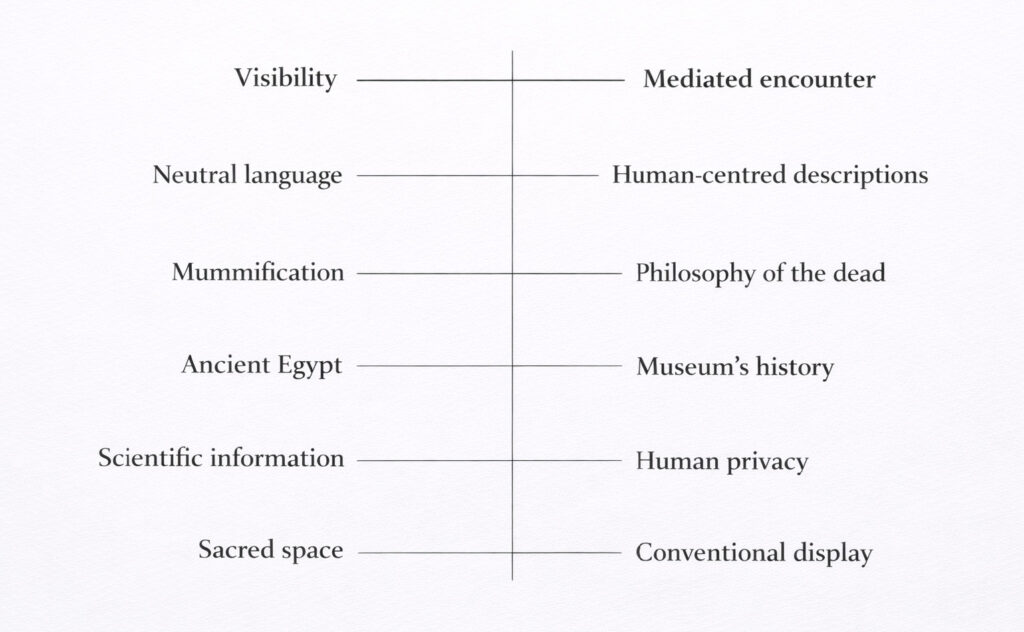
The design of the specific tension maps for each workshop I led on human remains in museums began with the mind mapping of core concepts surrounding the 21st-century display of Egyptian mummified bodies, such as conservation, ethics, bioethics, removal from display, emotions, institutional authority, and public trust. I drew these terms from recurring museum concerns (interpretation, narrative and practical display questions) and my own conversations with public audiences about their own feelings, including the discomfort of some visitors when faced with the viewing of dead bodies. The terms included on the tension maps needed to be understandable to non-specialist audiences; they needed to be neutral enough to not predetermine the results, and equally to be specific enough to generate outcomes that could directly inform museum redisplays. These terms were paired with their opposite value or competing priority, and added at either end of lines on a document (Fig. 2). A vertical line situates a middle-ground which can indicate that both values are equally important, or that the person is uncertain or can’t decide. Round sticky dots are used by participants to position responses along each horizontal line.
The delivery
Each workshop began with a 45-minute talk designed to equip the audience with the background knowledge needed to meaningfully engage with the topic. These talks set out the historical and ethical contexts that inform the display of Egyptian mummified bodies in museums, including questions of displacement, museum collecting practices, ethics and bioethics. Following the talk, the audience was introduced to the tension maps, and each tension was accompanied by a set of guiding questions used to make explicit the curatorial uncertainty or ethical challenge that underpins the tension. This is crucial because the maps are not abstract exercises; they are rooted in the decisions museums face when displaying the dead. For example, the tension between putting scientific data on display versus respecting privacy was introduced through these questions:
How should museums handle scientific and medical information about the dead? Should X-rays, CT scans, cause of death and illness be displayed or is this a bioethics issue in sharing the dead’s medical data without consent? Do the dead deserve medical privacy or is the information useful and interesting and therefore should be made accessible?
Each point of tension was introduced following this format, after which participants were invited to work in pairs and to place sticky dots along the lines to position themselves for each specific tension. In this way, a bridge was formed between the contextual talk and a room-wide discussion.
The workshops delivered in Derby and Leicester required minimal facilitation, as participants immediately began positioning themselves on the maps, engaging with their neighbours and comparing positions, demonstrating a real hunger for this kind of intellectual exchange and collective exercise. The fact that those workshops followed an initial lecture that gave contextual grounding played an important role in the success of these workshops, as the lecture and the explanation of the current tensions that museums face allowed the public to understand what the current challenges truly are; something surveys do not do successfully. But I believe that the simple analogue format also played an important role in this success: the use of physical maps and dots fostered authentic participation. Formats of engagement have become increasingly digital, while the maps were a simple yet effective way to recentre conversations and group discussions. The three workshops delivered in Derby and in Leicester gathered between 60 to 85 people on each occasion and were sold out, illustrating the public’s desire to be involved in discussions about museum displays. It confirmed that museums’ historic tendency to dilute, simplify or shy away from such conversations is counter-productive and erodes public trust. Conversely. honest conversations and engagement with the complexities behind institutional decision-making have the opposite effect, and the response to these workshops was overwhelmingly positive. Once invited to take part in ethics conversations, audiences enthusiastically engaged with the workshops, showing remarkable curiosity and a desire to contribute their views and opinions.
Rather than leaving visitors to assume that museums are making the right decisions, these workshops demonstrated that museums are grappling with competing responsibilities, and that they often struggle to find ‘the middle ground’ – something participants understood as they attempted to make those decisions on their own maps. Trust is built not by presenting cultural institutions as all-knowing, but by revealing how complex their decision-making processes really are.
The ‘mapping the tensions’ workshops are one tool that museums can harness to rebuild lines of communication with their audiences on complex and sensitive topics, but they are not a complete solution. The attendance remained limited in scale, and as such is not representative of all publics. Like many workshops and co-production initiatives, the long-term impact on visitors is difficult to evaluate. Yet each iteration has shown the value of creating space for these conversations. The turnout and positive feedback received for these workshops suggest a desire for more open, thoughtful engagement. The museum sector will not improve its public engagement by repeating familiar consultation formats; it needs creative methodologies that make more nuanced and stimulating public conversations possible. I believe the methodology I have outlined in this article represents one such creative strategy.