Youth is at the heart of our discussions in 2025, as it is one of the sub-themes of the ICOM General Conference in Dubai. The Publications, Documentation and Archives Department of the ICOM Secretariat has devoted a special issue of the academic journal Museum International to this topic, entitled ‘Youth, intangible heritage and new technologies in museums’, and has covered the subject in several articles of the ICOM Voices series.
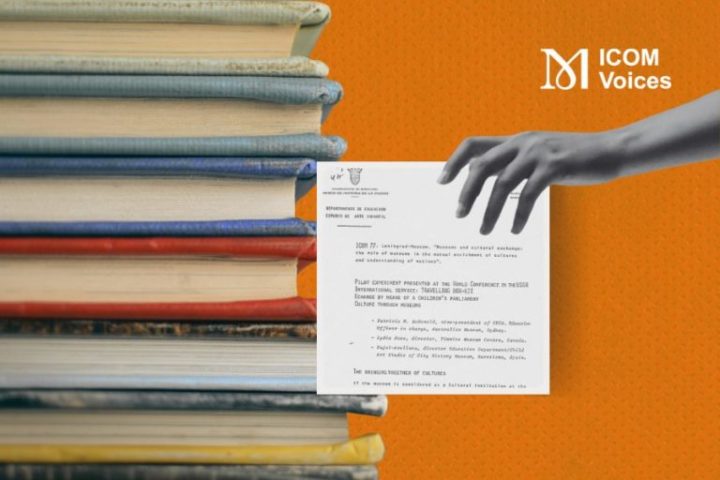
As the ICOM network gets ready to discuss the future of the museum sector at the General Conference in Dubai, we also invite you to take a look at its past with a document from our archives. Back in 1977, at its General Conference in Leningrad-Moscow in the USSR, ICOM was already interested in the involvement of young people in museums. A working group of the Committee for Education and Cultural Action (CECA) presented a pilot project called ‘Travelling Box-Kit’, developed by museums in several countries in collaboration with children’s parliaments.
This archival document is preserved at the ICOM Secretariat in both its French and English versions.
Access the archival document in French
Access the archival document in English
Transcription of the English version of this archival document, entitled ‘ICOM 77. Leningrad-Moscow. “Museums and cultural exchange: the role of museums in the mutual enrichment of cultures and understanding of nations”’.
PILOT EXPERIMENT PRESENTED AT THE WORLD CONFERENCE IN THE URSS INTERNATIONAL SERVICE: TRAVELLING BOX-KIT
EXCHANGE BY MEANS OF A CHILDREN’S PARLIAMENT CULTURE THROUGH MUSEUMS
– Patricia M. McDonald, vice-president of CECA. Education Officer in charge, Australian Museum, Sydney.
– Lydia Ross, director, Timmins Museum Centre, Canada.
– Pujol-Avellana, director Education Department/Child Art Studio of City History Museum, Barcelona, Spain.
THE BRINGING TOGETHER OF CULTURES
If the museum is considered as a Cultural Institution at the service of the community, it should be a tool for cultural communication, offering, in its own language, the knowledge of the inheritance of humanity in a living form, and not a mere store house for the treasures which it holds.
Education, especially that imparted in museums, must open the minds of the young visitors, using an outlook of new possibilities and changes of attitude. By a continuous chain of experiments, stimuli and personal development, the appreciation of the culture of other nations eliminates prejudices, and forms criteria which lead, as the general theme of this conference indicates, TO MUTUAL ENRICHMENT AND UNDERSTANDING, which thus allows the establishment of an open dialogue of high-standing.
In order to achieve this training it is necessary to break out of the national framework, and to step across frontiers. With this aim, the Department of Education, Child Art Studio of the City History Museum, plays its role, by promoting an INTERNATIONAL CULTURAL EXCHANGE FOR CHILDREN between the education departments of the Timmins Museum Centre of Canada; the Australian Museum of Sydney; and our History Museum of Barcelona. The first stage passed through, involved an initial contact and subsequent co-operation between the representatives of the aforesaid museums, during the international conference ICOM 75 (International Council of Museums) which took place in the Victoria and Albert Museum, in London.
It was agreed to put together in each museum a fully equipped ‘TRAVELLING BOX-KIT’ to be reciprocally exchanged, containing a careful selection, made by the children, of all types of materials, publications, minerals, costumes, handicraft, objects from everyday life, etc. − with the intention of presenting an image of a particular area of each country, i.e. Ontario, Sydney, and in our case Catalonia, as regards to its culture, industry, social life and history. The museums will take care of establishing a way in which to offer the material, once it has been received, to all the respective schools, so as to provide their pupils with a better understanding and assimilation of what is studied in text books.
There has thus been created an INTERNATIONAL SERVICE, similar to the loan services at a local level, which already exist in many countries, mainly begun in north-western Europe in the thirties, and which later spread to the rest of Europe and the other continents. The international projection of the cultural sphere of the museum aids decentralization, breaks the isolated privileges of exclusiveness and the property of an elite, and it thus achieves integration with the community. The museum FOR and WITH the people.
A CHILDREN’S PARLIAMENT
The principles followed in this Museum Education programme have been guided by a parallel movement of cooperation, and division of the responsibilities, with the neighbourhood community, schools, institutions and other bodies, with the aim of obtaining optimum conditions for inter-relation and contact between citizens and the museum, which might lead to a body which shares and decides the solving of its problems.
It is on these bases that the constitution of a CHILDREN’S PARLIAMENT is founded, in order to achieve the accomplishment of the “TRAVELLING BOX-KIT” exchange. A heterogeneous assembly formed by the museum, instructors and a group of boys and girls called the researchers, members of the U.E.C. and coming from various types of schools. A museum FOR the people and WITH the people, adapted to the modern world in its socio-cultural aspects: city and museum, children and adults, a new ideology which protects the liberty of expression, providing the possibility for individuals to exercise their initiative or creative ability, changing a passive and receiving attitude for one of giving and participation. The children have been conscious of carrying out work destined to be of use to their companions of Catalonia.
TECHNICAL PROCEDURE
The assembly process has been based on the rules adopted by the ‘JAYCEES INTERNATIONAL’, and similar to those used by the legislative bodies of all the countries of the world, for free discussion. Orderly meetings which provided better understanding and with equal opportunity for all to speak. Decisions by the majority, and the protection of the rights of the minority. The meetings took place in the Child Art Studio of this museum during one and a half academic years, and were organized once a forthnight, from 7 to 9 in the evening, in order to prepare sufficiently.
For a better understanding of the working methods, the children adopted their own modifications and forms of the parliamentary rules, which they studied by themselves for a period, making the system simpler and less ponderous. In short, the children were given the responsibility of this experiment, as the decision-makers of the course that it should take, whether this was the best or of less value, without the slightest adult pressure.
The work was distributed among four groups, each with a duty, and a colour – red, blue, yellow, green – and under a leader or head, there being a correlation between group, colour and subject. For exemple, the blue group was concerned with the problems of the Mediterranean, a matter principally proposed, with great interest, by Australia.
Questionnaires were presented to fishermen concerning the contamination of waters, and a collection of newspaper cuttings about ecology, as well as a series of works and accounts on the environment, were put together. The more active members gathered the material decided on at each meeting, checked or asked for contributions on the subjects; the more academic and intellectual investigated and wrote down their impressions. In order to obtain new ideas and to effectively explore and initial list of objects and subjects, the technique of ‘brainstorming’ was used, which provided fruitful suggestions. Several children corresponded with their foreign counterparts, giving rise to useful relations and links of friendship.
ORGANIZATION OF THE MEETINGS
Since it was a matter of a group in course of formation, the first session was opened by the director of the Department of Education, so that once it had been declared begun, this might give an opportunity for a president to be selected, of for the same person to be invited to continue presiding over the discussions.
Agreements were reached and duties allocated by voting. At each meeting the secretary would read the order of the day for approval. After this they continued with the passing on of the news of the directing body and heads of the groups, this being followed by matters in hand, general questions, and new projects, etc. finishing off with question time.
PERMISSION TO SPEAK
One child acted as controller or coordinator, giving permission to speak to whoever had asked first, by raising his hand, always presuming that the previous speaker had finished.
THE MOTION
The proposal of what was wanted to be done, or the motion the means of action of the group, was limited to a single type, without distinction between main and subsidiary points, incidental ones and those of privilege points, or those simply concerning procedure, such as appeal amendment, temporary suspension of the rules, etc. Once the motion had been presented, it had to be seconded or supported by someone in the group, with the aim of making sure that the matter raised was of interest. When the debate was over, the motion was accepted or rejected by a straightforward majority vote, by a showing of hands, i.e. a half plus one.
RESULTS AND EXPERIMENTS
The parliament showed an increasing level of enthusiasm and excitement, and reached a point of instability and testing, because of an excess of amendments and continual alterations. The rules were temporarily suspended while reconsidering the structure and analysis of each one. The experiment was very useful and had positive results. The group had matured, and returned to the parliamentary procedure with a new feeling of presence of mind, and being fully aware of the consequences of the decisions that it freely made, and conscious of the value of the commitment acquired. The common cause provided practical experience of participation; the children have learned to speak clearly and concisely, without being afraid to stand up and make a declaration, and have accepted and respected the right of others to hold an opinion.
COMMUNITY PARTICIPATION
The above programme has been shared by the community. Individuals and both private and public institutions have cooperated in the formation of and contributions to, part of the material included in the ‘TRAVELLING BOX-KIT’.
EXHIBITION IN THE USSR, ICOM 77
This International Exchange for children was incorporated into the general context of the activities of the working party on kits during study sessions of the CECA 77 (Committee for Education and Cultural Action Conference in Umeå, Sweden, as an unpublished contribution of an interesting experiment to be presented in the USSR at the ICOM 77 Conference, in accordance with its theme indicated by the title mentioned above.
In Leningrad, in a room of the Hermitage Museum reserved by CECA, there has been installed, along with the two kits from Sweden and West Germany, a photographic report on this exchange for children, which has already been conveniently referred to in Ger van Wegen’ s report.
The “working party on kits” concludes in Moscow with a final account by its president M. Jean Favière.
This initial experiment hopes to give rise to new projects and to encourage all museums to begin a process of bringing together peoples and cultures. Through a living exchange, the children taking part benefit from a many-faceted educational experience, which will help them to distinguish and appreciate, within an overall context, the specific points of one culture or another. The contributions of opinions and suggestions by everybody will help, without doubt, to improve what has been fulfilled.
PUJOL-AVELLANA
INTERNATIONAL EXCHANGE: ‘TRAVELLING BOX-KIT’
EXECUTIVE OF THE CHILDREN’S PARLIAMENT
CONSTITUTED BY:
Group “the boys and girls researchers” of the U.E.C. (Unió Excursionista de Catalunya) who come from various types of schools (11-12 years old) : X. Roman, E. I. Bohigas, M. L. Moreno, M. Dachs, A. Just, A. Salgado, A. Pinell, E. Martinez, J. de Ramón, J. Tolrá, O. Arisó, P. Segura, E. Balada, N. Mir, R. Más, J. Olivé, O. Calpe, L. Masvidal, D. Torrent, V. Bassas, A. Cid, I. Más, M. Pañella.
Robert Hijar and Roser Castelló, instructors (U.E.C.) and prof. Pujol-Avellana director of “Departamento de Educación Estudio de Arte lnfantil del Museo de Historia de la Ciudad.
COLLABORATORS:
AYUNTAMIENTO DE BARCELONA
INSTITUTO MUNICIPAL DE EDUCACION
DIPUTACION PROVINCIAL DE BARCELONA/PALAU DE LA GENERALITAT
OMNIUM CULTURAL/DELEGACIO D’ENSENYAMENT DE CATALA DEC
CONGRÉS DE CULTURA CATALANA
JOVEN CAMARA DE BARCELONA
INSTITUTO DE INVESTIGACION PESQUERAS
AYUNTAMIENTO DE TARRAGONA
JOVEN CAMARA DE TARRAGONA
ESCOLES MIRAMAR DE HOSPITALET DEL LLOBREGAT
ESCUELA SUIZA DE BARCELONA
ESCUE’LA NACIONAL DE SAN BAUDILIO DEL LLOBREGAT
Photographic report to be exhibited in the USSR
Carlos Pérez de Rozas
Colour photographs
Cecilio Petriz
Miquel Batet
EDUCATION DEPARTAMENT / CHILD ART STUDIO IN THE CITY HISTORY MUSEUM
PRECEDENTS
1968 National Exhibition of ‘Creative Freedom’ in the Museum’s Royal Hall Called ‘Tinell’ as a promotion and re-evaluation of children’s art.
1969 International Exhibition of ‘Creative Freedom’ held in the Museum’s Royal Hall Called ‘Tinell’ as a world wide world testimony of the importance of education through art. Creation of awareness among parents and teachers.
OFFICIAL INAUGURATION
1973 Establishment of the ‘EDUCATION DEPARTAMENT/CHILD ART STUDIO’ of the CITY HISTORY MUSEUM.
IDEOLOGICAL MOTIVES
A very important basis in contemporary education is the child approach to the museum. Visual experience and direct contact with materials enrich and make the study of books more fruitful, and facilitate a better depth of understanding of his subjects.
The scholars learn to formulate valuable judgments on how the museum is used. It stimulates them to discover and explore by themselves, and gives them the desire to get to know other museums and to study the objects forming part of their environment.
The fundamental proposal is to learn to follow an active line, by means of the responsible and active participation of educators and children, always bearing in mind the initiatives and contributions of both. This results in the bringing of benefits to the community and a sociological-cultural continuity, that is to say, a contact with the city which will produce an increase in intellectual wealth research and information, exchanges in the specialised international circle and interrelations among the museums of Barcelona and the province.
This teaching plan is based on the child and his stages of mental development through which he passes. Not subject to, but compatible with the present or future education, it is a self contained programme at the service of the child and of the community.
AIMS
A return to the origins of history as a major procedure in re-considering today’s values.
Basis of understanding, the evolutionary process of art and history as a consequence of the foregoing. Enrichment of the present lack of sensitivity, vibrating in the presence of beauty.
Raising all the popular.
Reconstruction of forgotten or unknown values in the History of Manking, especially of the earth itself.
DIDACTICAL PROGRAMMING
This is carried out by a course of programmed visits to the Museum oriented by guide books which have been published by this Departament for children and their teachers. At the end of each visit, the children in the Child Art Studio have the opportunity of expressing themselves by painting or drawing their impressions feelings and observations, under a process of personal creativity. In this manner they fix their attention and assimilate better what they have seen. Art is an important form of communication. After every session a process of consideration of results takes place by means of questionnaires given to the children and dialogues with the teachers responsibles. The children give their opinions and they are conscious of the importance given to their personality.
Complementary visits to other places of interest commented on by technician of the Museum, accompanied by historically and aesthetically instructional leaflets and creative art work.
Monographic visits and activities for children at cultural events.
Work meetings with teachers and parents. Children’s Parliement, Concerts, children’s competitions, summer courses. Art exhibitions, theatre, among other formative activities. International Cultural Exchange between museums: ‘Travelling Box-Kit’.
An educational programme is neither definitive nor finished. All planning is re-constructed and modified in the course of experience and it is, presented here and ready to accept new initiatives and ideas.
PS.
This presentation was given by Pujol Avellana with slides during the plenary session on Tuesday 25th in Moscow, at the invitation of I. Nikiforova, Secretary General of the Soviet Committee of ICOM.
The creation of a new international ‘Travelling Box-kit’ service for children’s exchanges between museums clearly had a strong impact on the delegates, especially those from northern and central Europe. There were many congratulations after the conference and subsequently by letter.