

Dr Emma J. McAlister
Curator and academic
Museums have no borders,
they have a network
August 10, 2026
Dr Emma J. McAlister
Curator and academic
Keywords: Exploitation, Casualisation, Care, Risk, Workers
Even with years of experience and postgraduate qualifications, there are no guarantees of being offered a job. A permanent position would be rarer still, with many museum professionals hired on fixed-term contracts for short-term projects. If hired, there is an expectation of gratitude, regardless of low pay, stretched resources and, in some cases, bullying from those higher up the hierarchy.
Often deeply felt as a personal failure, these negative work experiences are widely experienced across the Irish museum sector and impact many professionals. However, this is not a personal or individual problem: it is an institutional, structural and sector-based failure. The casualisation of museum staff is detrimental to professional practice, namely in terms of maintaining research, record management and, more broadly, the reputation of museums. As I will explain, expectations candidates hold around working in the museum sector are far from the reality. It is therefore necessary to consider ways of improving the museum sector, and what senior permanent staff and museum management can do to achieve this.
I always wanted to work in a museum. I excelled in subjects such as history and art in school, and I felt that working in a museum would marry these two interests perfectly. In my years of teaching undergraduate history and postgraduate arts management at Queen’s University Belfast, I can see my previous expectations of what museum work would be like reflected in my students’ aspirations and assumptions of museum work – that museums are safe spaces where knowledge is produced and exchanged; places where you can ‘go behind the scenes’ and work with amazing collections.
These expectations are re-enforced in the media in the United Kingdom and Ireland with television shows such as the BBC’s ‘Secrets of the Museum’ and RTÉ’s ‘Ireland’s Hidden Treasures’[1] where museum professionals offer an audience a ‘sneak peek’ into working in the hidden sanctums of museums.
I believe that museum work is ordinary skilled labour that is often placed on a pedestal. The idea that museum work is particularly special results in normalising low pay and poor working conditions in exchange for the ‘dream job’. Museum work should be awarded with adequate remuneration and safe working conditions.
Supportive peers and friendships
Museums can be incredible and joyful places to work because of colleagues, visitors and communities involved in outreach programmes.
Through working in various museums and art galleries, I have met and worked with some of the most intelligent, interesting and caring people that put their heart and soul into their work. I was privileged to be part of an installation team that worked to create the largest permanent exhibition about 20th-century Irish history on the island. Owing to the scale of this exhibition, I worked with expert curators, educators, conservators of different disciplines and incredible freelance staff such as mount makers and designers.
These professionals, who work directly with objects and communities, have a wealth of museological knowledge and they care deeply about creating exhibitions that are accessible and engaging for visitors.
Volunteering and temporary contracts
However, an ongoing exploitative practice is the sector’s reliance on a casual or volunteer workforce. I am fully aware that museums and other cultural institutions are hugely underfunded and that, now, the future of funding museums looks bleaker than ever. Nonetheless, lack of funding is not an excuse for lack of care for workers.
Unfortunately, a prevailing attitude towards museum work is that it is such an aspirational job that those looking for entry-level work should expect to undertake free labour by volunteering. This attitude had been ongoing long before I started my MA in Museum Studies in 2014, and I still hear museum staff and academics advising young people to volunteer if they want to have a career in museums.
I volunteered in many different museums, art galleries and festivals for years, and most of that free labour involved cleaning exhibitions and invigilation. There must be more thought about which skills can be learned through volunteering and what the museum must teach in exchange for the free labour given. At the moment, the expectation that you must spend time doing free labour is elitist and contrary to the museum’s mission of inclusivity – i.e. if a person cannot afford to provide free labour, are they then excluded from working in the sector? Over reliance on volunteers can exclude individuals with limited resources from ever establishing a museum career.
Moreover, unpaid labour and working from contract to contract is exhausting.
There should be more recognition of the invisible labour of continually searching and applying for jobs when many people feel ‘permanently temporary’. The result of precarious employment is a constant requirement of going ‘above and beyond’ and the never-ending cycle of proving yourself worthy of being there. This is not healthy or sustainable in creating a strong workforce.
In my most recent job in a museum, I worked for a third-party recruitment agency on a rolling temporary contract for two and a half years. On two occasions, I and three team members were not told that our contract had been renewed until a day or two before the contract was due to end. By the end of our final contract, the morale of the team and trust in the institution had been eroded.
Once the team’s contracts had ended, it was also challenging for the staff left behind. This loss was often personal, given the close friendships, and was further complicated by the resulting pressure of an increased workload. Moreover, handover notes and meetings cannot fully capture the years of institutional knowledge that depart with these team members when their contracts end.
I am also painfully aware that when you are hired temporarily, the staff hierarchy places precarious staff at the very bottom. This can enable abuses of power, such as delegating skilled workers towards menial tasks. Workforce imbalance can lead to the mistreatment of talented, passionate staff who simply want to professionally advance in the sector.
Toxic workplaces
It is an open secret that some museums in Ireland are toxic work environments.
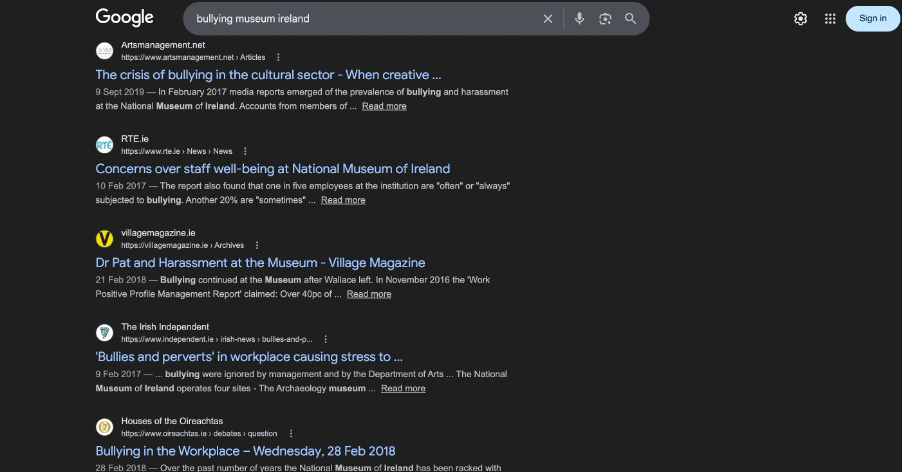
A quick Google search using the keywords ‘bullying museum ireland’ reveals some shocking examples of bullying and sexual harassment, with many accounts published by credible and well-known news sources and governmental bodies such as The Irish Independent and Houses of the Oireachtas.
I have witnessed and experienced mistreatment, unprofessional behaviour and bullying in varying degrees.
As someone on a fixed-term contract, calling out bad behaviour or making a formal complaint is extremely challenging. Unfortunately, I was compelled to lodge a formal complaint after a series of incidents. At first, I had the upmost support and encouragement from management. After I came back from a short period of annual leave, I quickly realised something had changed when I was told I just had to deal with ‘negative personalities’ and be more ‘resilient’.
Under Ireland’s Dignity at Work Policy, an investigation should not ‘exceed more than three months’.[2] Human Resources did not provide the report of the formal investigation, which included an official apology on behalf of the museum, until ten months after I lodged my complaint − just two days before the end of my final contract. On my last day (and twenty minutes before I handed back my work laptop), I received an email from Human Resources with an apology in writing and assurances that they would implement training with a ‘specific focus on enhancing managers’ skills in the area of sensitive conversations’, after management spoke to me in an attempt to dismiss my concerns after several harmful incidents had occurred.
The way in which management and Human Resources dealt with a serious complaint was inadequate and damaging. As discussed above, this incident happened after many reports by news outlets exposing evidence of long-term and historical bullying and sexual harassment. The result is that, even as recently as in 2025, when something serious happened to a member of staff, the institution did not have the resources or competence to protect the most vulnerable members of their workforce.
Even after these toxic practices were publicly exposed, a culture persists among some staff: one that holds that the museum’s prestige justifies the sacrifice of personal lives and mental health.
While museums have the potential to be wonderful safe havens for young professionals to nurture their careers, the Irish museum sector must now face a long-overdue reckoning.
For many skilled workers across the island of Ireland, a career in museums is not sustainable or even aspirational within current conditions. Talented people are leaving the sector not only because their contracts have ended, but because of the mental burnout caused by lack of staff resources or toxic work environments.
There are questions that need to be considered and actively responded to, such as:
Let’s open the conversation to create meaningful steps towards care and better working conditions for museum professionals.
Notes
[1] BBC: British Broadcasting Corporation; RTÉ: Raidió Teilifís Éireann [Radio Television of Ireland].
[2] See: https://assets.gov.ie/static/documents/dignity-at-work-an-anti-bullying-harassment-and-sexual-harassment-policy-for-the-state.pdf. Section 28, page 15.
Editor’s note: In this article, the author has chosen to use ‘the island of Ireland’ to refer to Ireland and Northern Ireland.
Article illustration created using the photo ‘stairs’ published by Georgie Pauwels on Unsplash. CC BY 2.0.