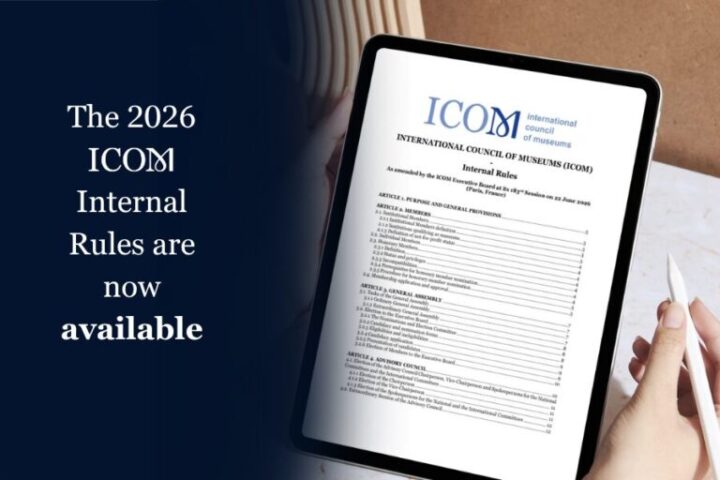
At its 183rd Session (22–23 June 2026), the ICOM Executive Board adopted the revised ICOM Internal Rules, bringing to a close a three-year review process.
The revised Internal Rules do more than align with the 2023 ICOM Statutes: they modernise governance across ICOM by clarifying institutional responsibilities, strengthening legal certainty, and, among others, introducing dedicated personal data protection provisions.
What is changing?
The revised Internal Rules introduce several substantive changes that will shape the way ICOM operates:
- alignment with the 2023 ICOM Statutes;
- clearer and more consistent governance rules across National and International Committees, Regional Alliances and other ICOM bodies;
- creation of a new Article 11 dedicated to personal data protection and GDPR compliance;
- formal establishment of the Strategic Plan Committee (SPC) and the Standing Committee on Decolonisation (SCD) as permanent Standing Committees;
- simplified drafting and improved legal clarity throughout the text.
These changes provide ICOM members with a more coherent and operational governance framework while reflecting the Organisation’s current practices.
Why the Internal Rules matter
The Internal Rules are ICOM’s second core governing text after the Statutes. They transform the principles established in the Statutes into the operational rules governing how the Organisation functions covering membership, the General Assembly and Advisory Council, National and International Committees, Regional Alliances, Affiliated Organisations, Standing Committees, Working Groups and more.
Following the adoption of the revised Statutes in 2023, updating the Internal Rules became essential to restore consistency across ICOM’s governance framework. The previous version dated from 2017 and no longer fully reflected either the Statutes or the Organisation’s current governance practices.
Ten articles reviewed, one article created
All ten existing articles have been revised, and a new article has been introduced (article 11). Together, these amendments modernise the Internal Rules while bringing them into line with ICOM’s evolving governance framework.
Article 1 – Purpose and General Provisions has been reorganised to place the hierarchy of ICOM’s governing documents at the beginning of the text, establishing a clearer legal framework from the outset.
Article 2 – Members has been updated to align membership provisions with the 2022 museum definition and the 2023 Statutes.
Article 3 – General Assembly has been revised to reflect the governance arrangements established by the 2023 Statutes.
Article 5 – Standing Committees and Working Groups has been substantially revised to formalise two important institutional developments. The Strategic Plan Committee (SPC) and the Standing Committee on Decolonisation (SCD) have been elevated from temporary working groups to permanent Standing Committees, in line with Resolution 6 adopted by the General Assembly, which called for the establishment of a dedicated Standing Committee on Decolonisation.
Articles 6, 7 and 8 – National Committees, International Committees and Regional Alliances have been extensively updated to align the provisions with current organisational practice and to strengthen consistency across ICOM’s governance structure.
The new Article 11 – Personal Data Protection addresses an increasingly important area of governance. The ICOM Internal Rules adopted in June 2017 (i.e. one year before the entry into force of the General Data Protection Regulation (GDPR) in May 2018), did not contain any provisions on personal data protection. Developed in consultation with ICOM’s Data Protection Officer (DPO), the new article establishes a dedicated framework for the protection of personal data within ICOM’s governance documents and aligns the Organisation’s governance framework with applicable European data-protection requirements and current best practice. The reform also directly responds to Recommendation 3 of the International Committees for 2025, which called on ICOM to reinforce personal data protection standards and strengthen GDPR compliance across the Organisation.
Beyond ensuring consistency, the revision seeks to strengthen the clarity, stability, and effectiveness of ICOM’s governance framework. The revision pursued five main objectives:
- to align the Internal Rules with the ICOM Statutes, as amended in June 2023;
- to simplify and clarify their language and structure;
- to improve transparency and legal certainty;
- to harmonise provisions across ICOM’s various bodies and organs; and
- to reflect the Organisation’s current practices and operational realities.
A three-year process of consultation and review
The revision is the result of a three-year process led by the Working Group on Statutes and Rules (WGSR) under the co-chairmanship of Kate Seymour (ICOM Netherlands, ICOM-CC) and Alexandre Chevalier (ICOM Belgium, ICOM Europe), working in close cooperation with the Executive Board and the Secretariat.
The revised Internal Rules entered into force on 22 June 2026, upon their adoption by the Executive Board at its 183rd Session (22–23 June 2026). They now constitute the reference framework governing ICOM’s internal functioning and the activities of its various bodies, alongside the Statutes.
The successful completion of this three-year revision process is the result of a collective effort involving the WGSR, the Executive Board, and key representatives from across ICOM and the Secretariat.
The revised Internal Rules provide a modern governance framework designed to support ICOM’s evolving institutional needs. The effective implementation of the revised Internal Rules now represents a shared responsibility across the Organisation: ensuring that they serve not only as a governing document, but also as a practical tool to support ICOM’s work and advance its global mission.
The document is available at all times in the ICOM Member Space, under ICOM’s core governance documents, in ICOM’s three official languages.
***
For further information or any questions regarding the revised ICOM Internal Rules, you may contact the ICOM Legal Affairs Unit at: legal@icom.museum.