
Ann Blokland and Sarah Broekhoven
Curators of Education at the Van Gogh Museum, Amsterdam
Museums have no borders,
they have a network
October 9, 2026
Ann Blokland and Sarah Broekhoven
Curators of Education at the Van Gogh Museum, Amsterdam
The Van Gogh Museum uses the life, work and times of Vincent Van Gogh to inspire a diverse audience. One important element of the artist’s life story is his struggle with his mental health. In his letters, some 800 of which are in the museum’s collection, Van Gogh openly discusses his ideals, his doubts, his ambitions as an artist and, later, his psychological problems [1]. Van Gogh’s story is that of a person who is vulnerable yet strong, which can serve as a springboard for discussions about mental health. Van Gogh found a firm footing in his artistic practice, and he hoped that his art – in which he set out to express the essence of human life – would give comfort to others.
Mental health has become a broader social issue in recent years. Media reports that respond to various studies reveal concerning trends: for example, a large number of young people suffer from performance anxiety, stress, burnout and depression [2], and one in four people in the world will suffer from psychological problems like depression or anxiety at some point in their lives [3]. Yet, despite the fact that mental health problems are so widespread, they remain stigmatised, negatively stereotyped and greatly misunderstood. Van Gogh has gradually come to be seen as the archetype of the artistic ‘mad genius’; it is important to dispel this image, and to instead view his mental health problems as just one facet of his identity amongst many others.
With its ‘Open Up with Vincent’ programme, launched in 2022, the Van Gogh Museum wishes to foster more openness about mental health, using Van Gogh’s own story and art as a foundation. By introducing people to new ways of looking at art, and allowing them to experience their own artistic creativity, we hope to show that art can be a powerful tool of communication, creation, emotion, reflection and connection [4]. In this endeavour, the museum does not operate like a healthcare institution, but as a cultural meeting place that invites people to become aware of the issue, develop understanding and engage in dialogue. Since we launched a number of small pilot projects in 2022, the programme has evolved into a varied range of offerings for a wide audience, as well as for specific groups.
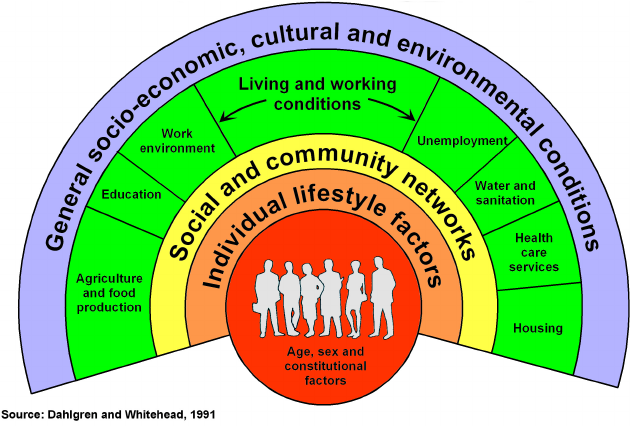
As is the case for most art museums, the Van Gogh Museum’s expertise does not lie in the field of mental health. It was therefore important for us to explore this field in more depth, learn its terminology and discover what we might offer various groups through our activities. While in the early stages of the project we investigated how our institution could help individual participants, the museum currently approaches mental health more as a social issue that is part of a complex social ecosystem. This is in line with Dahlgren and Whitehead’s ‘Rainbow Model’ [5] and the ‘Positive Health’ model [6], which envisages mental health not as an exclusively as an individual characteristic, but as something that emerges in interaction between individuals, social networks, organisations and cultural norms. The museum therefore focuses on three different levels: the individual (orange), social networks (yellow) and living and working conditions (green), as shown in Figure 1. Collaboration with healthcare institutions, educational institutions and social partners creates a network for participants, with the museum acting as a non-clinical place where they can briefly escape daily life.
The ‘Open Up with Vincent’ programme includes both widely accessible activities for all museum visitors and tailored activities for special groups or communities [7]. This variety emerged during the early years; while at the time we were focused on co-creating offerings with healthcare professionals and young adults based on their needs in terms of mental wellbeing, it became clear that there was broader interest in the programme.
Weekly walk-in workshops
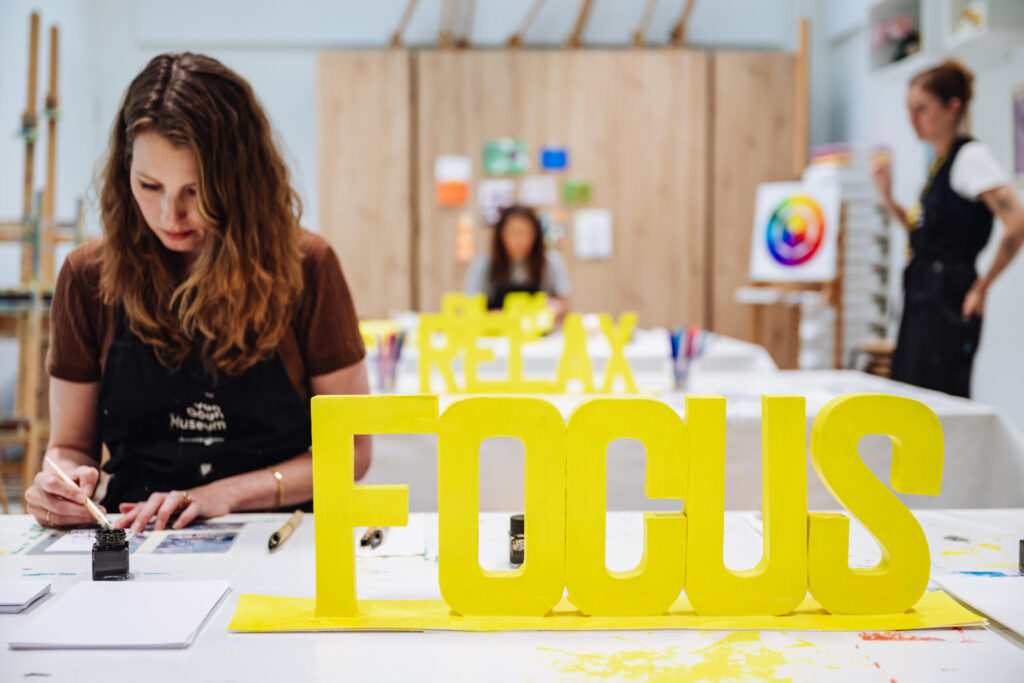
The museum has recently started offering accessible walk-in workshops for visitors aged 12 and over every Friday afternoon. Under the supervision of a workshop instructor, participants create a piece of art based on a theme such as focus, calm, nature and flow, inspired by Van Gogh [8]. The workshops provide an opportunity for reflection, relaxation and creativity –whether individual or collective.
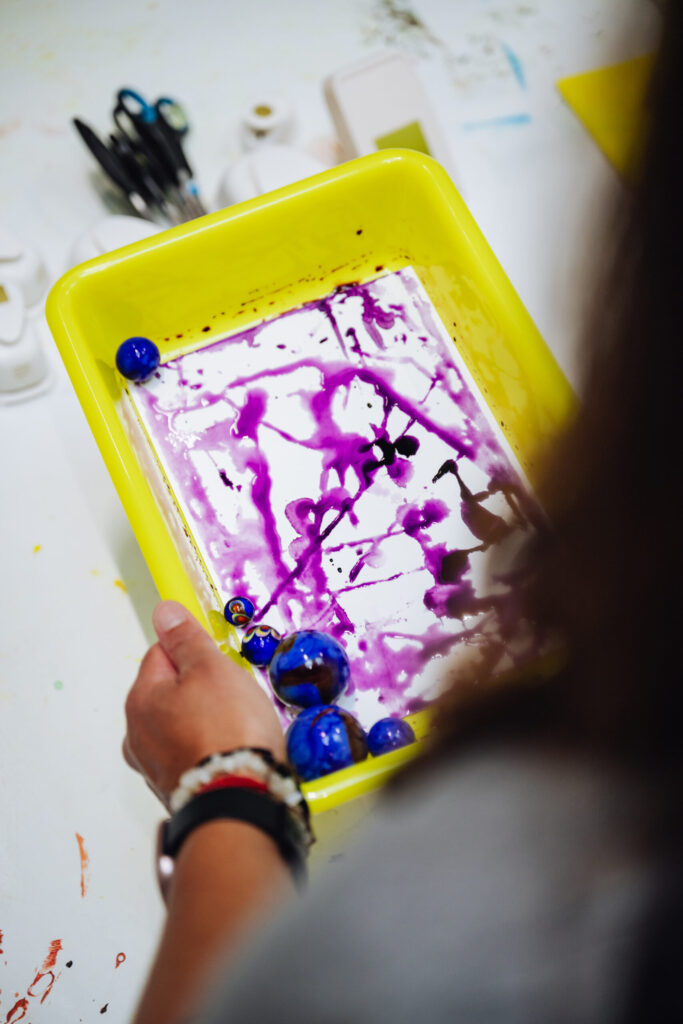
Visitors can choose from among three activities. In RELAX, they can colour in a Van Gogh-inspired picture, promoting relaxation and mindfulness. One participant in this workshop noted: ‘I feel 1,000 times more chilled than when I came in’, while another remarked, ‘I was completely focused on the task, and time flew by’. The FOCUS activity involves making a pen-and-ink copy of a detail from a work by Van Gogh, encouraging concentration and fulfilment. One participant described the experience as immersive and calming, saying it felt ‘like time travel’ and it brought ‘some bliss’. In PLAY, meanwhile, visitors experiment with coloured inks, marbles and shape hole punches, encouraging creativity, exploration and a sense of flow.
It was striking that a large proportion of the participants at these walk-in workshops were young adults (aged 18 to 35), and that there was no clear preference for any specific theme. The choice was regarded as stimulating. Participants stayed for an average of 30 minutes, but we have also had people who stayed for two hours to take part in all three activities. We now have 40 to 100 participants every Friday afternoon.
Monthly ‘slow looking’ tours
Another accessible way of focusing on and offering tools for mental wellbeing is our monthly Slow Art tour, which is open to groups of up to 12 participants. The tour is all about ‘slow looking’, or taking the time to really see and appreciate works of art by Van Gogh and their details [9]. This activity creates a sense of calm and counterbalances the rapid motions of scanning, scrolling and swiping in our daily lives. It is a way to forge deeper connections with art, while also connecting with other participants by sharing experiences. This element of exchange and dialogue shifts the activity from ‘individual’ to ‘collective’. The Slow Art tours are guided by a museum docent, who allocates certain assignments. We are keen to encourage participants to continue to practise slow looking, and are considering offering tips immediately after the tour or on our website, which participants might then use during other museum visits.
Through these activities, the museum actively offers support at an individual level to a wide-ranging audience, reaching many people. However, it is also investing at the social network level by entering into local partnerships with civil society organisations.
Although activities organised in collaboration with local organisations require more time to plan and set up than those organised solely by the museum, and have a relatively limited reach, they do have a significant impact. The partnerships established to implement them are long-lasting, and the museum’s own learning curve is enormous. When the museum works with a care institution, social workers are always present during the sessions: the museum provides creative activities and assignments, and they ensure everyone’s safety. It is here that the two different fields – art and mental healthcare – really do come together.
Co-creating a community mental health programme with GGZ Zuid
In 2023, the museum partnered with GGZ Zuid (the municipal mental healthcare service), their clients and support staff, to create a tailored mental health activity. This activity, during which a GGZ patient shares their personal story of recovery, combines a guided tour with a painting workshop at the museum. A small group, comprising no more than 10 participants, meets three times a year in this context. The painting workshop involves a brief meditation session, after which participants create a landscape with colour based on emotion and intuition, in the same way that Van Gogh sought to express feelings with colour. As sharing experiences is an important element of this activity, the GGZ companion creates a climate of trust conducive to such exchanges.
The programme has also inspired GGZ staff as one team member remarked:
‘What a fabulous part of my job, the visits by people from the local community to the Van Gogh Museum. Mental health versus art. How amazing that talking about things becomes so easy, and participants are moved by each other’s art!’
As well as this type of positive feedback, we have also received useful tips. We learned, for example, that a significant proportion of people receiving mental healthcare services have some form of cognitive impairment that is usually invisible. We were therefore advised that it would be better to keep language used as part of the activities simple, ensuring that everyone can understand and follow them more easily.
A collaboration with Levvel
In 2023, the museum also started collaborating with Levvel, an organisation that helps young people and families cope with complex problems, linking care, personal development and participants’ everyday realities. To get to know each other, we began by offering various activities on- and off-site for young people during the holidays. The short outreach painting workshops, which saw museum staff travel to the partner’s site of operation, proved to be the most accessible, both for youngsters and for Levvel.
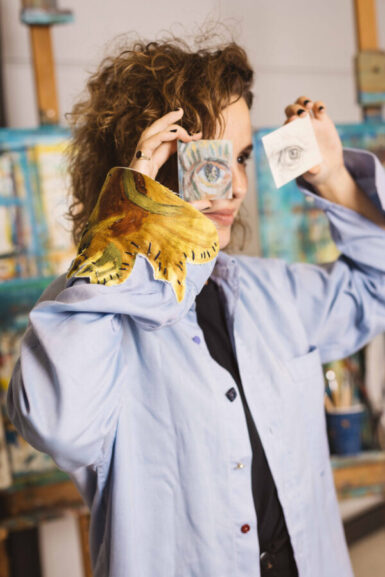
Participant feedback was generally quite positive. At the end of a session, one participant remarked ‘Why weren’t there workshops like this before? I would really have liked to do that [sooner]’. Following similar positive responses from the young participants, workshop leaders and Levvel staff members, we grew more ambitious and jointly organised an intensive programme called ‘Mental Narratives’. Young people could sign up for a series of three-day workshops at which they would work with an artist to create individual works of art, in a medium selected by the participants themselves (textile, mixed media or music).
Each group was composed of up to eight young participants alongside support staff. The workshop began with a get-to-know-you session and a guided museum tour, as well as an explanation of the framework for the activities. The museum studio, where the workshops were held, was a calm place in an institution with an otherwise dynamic atmosphere. The workshop ended with a photoshoot during which participants could have their photograph taken, choosing whether to be identifiable in the images or not.
Thanks to this project, we now have a better idea of the potential and limitations of the two organisations, as well as the needs of young people, which include connecting with each other, experiencing art, pleasure and relaxation, and gaining an opportunity to improve their creative self-confidence.
Based on these experiences, Levvel and the Van Gogh Museum are now focusing on building 60-minute multisensory outreach painting workshops to be held throughout the year, on themes including autonomy and developing one’s identity. We are also offering in-depth workshops (120 mins) at the museum, as part of our holiday programme, and exploring the possibility of incorporating workshops into Levvel’s healthcare processes.
Further research on the programme’s impact
The museum continues to monitor these different activities, and is launching pilot projects to test new offerings. This gives us participant feedback (both spontaneous and via evaluation forms), which allows us to make improvements, often in collaboration with our partners. The response has been broadly positive, and the subject of mental health is generally considered appropriate for the Van Gogh Museum. But how can we ascertain whether we are achieving our goals across the entire programme? Do our resources and activities have an impact on the mental wellbeing of participants? Are we helping to make discussion of the issue easier, and are we creating more awareness and understanding around mental health? To answer these questions, in 2026 the museum is launching a three-year, subsidised impact study on ‘Open Up with Vincent’, led by a research group with clinical and academic expertise in the field of mental health. This will give us a clearer view of how we, as a museum, can more effectively help to bring about a shift in cultural norms, ensuring that mental health is increasingly seen as a shared social responsibility.
Notes
[1] All of Vincent Van Gogh’s letters can be found at vangoghletters.org
[2] Persistent concerns about young adults’ mental health despite slight improvement | RIVM / Rijksinstituut voor Volksgezondheid en Milieu (RIVM), Monitor mentale gezondheid. Landelijke rapportage, 2025.
[3] AXA Mind Health Report, 2025 ipsos.com/nl-nl/axa-mind-health-report-mentale-gezondheid-blijft-wereldwijd-verslechteren / NEMESIS-3-onderzoek Cijfers psychische gezondheid – Trimbos-instituut.
[4] On the positive effects of the arts, see for example: Daisy Fancourt, Art Cure: The Science of How the Arts Transform Our Health, 2026; Susan Magsamen & Ivy Ross, Your Brain on Art: How the Arts Transform Us, 2023; World Health Organization (WHO), What is the evidence on the role of the arts in improving health and well-being? A scoping review, 2019 www.who.int/europe/publications/i/item/9789289054553
[5] Dahlgren, G. and Whitehead, M. Policies and Strategies to Promote Social Equity in Health. Stockholm: Institute for Futures Studies, 1991.
[6] Huber, M., Jung, H.P., Brekel-Dijkstra, van den, K., Handboek Positieve Gezondheid in de huisartspraktijk, Bohn Stafleu van Loghum in Houten, 2021.
[7] The museum welcomed approx. 1.8 million visitors in 2025, most of them international. https://www.vangoghmuseum.nl/en/about/organisation/annual-report
[8] Csikszentmihalyi, M., Flow: The Psychology of Optimal Experience. HarperCollins, 1990.
[9] Tishman, S., Slow Looking: The Art and Practice of Learning Through Observation, 2017.